
Close Menu
    Facebook X (Twitter) Instagram
    SciTechDaily
    • Biology
    • Chemistry
    • Earth
    • Health
    • Physics
    • Science
    • Space
    • Technology
    Facebook X (Twitter) Pinterest YouTube RSS
    SciTechDaily
    Home»Technology»U.S. Army Project Boosts 5G and mm-Wave Technologies With Over 100 GHz Carbon Nanotube Transistors
    Technology

    U.S. Army Project Boosts 5G and mm-Wave Technologies With Over 100 GHz Carbon Nanotube Transistors

    By U.S. Army Research LaboratoryNovember 21, 2019No Comments3 Mins Read
    Facebook Twitter Pinterest Telegram LinkedIn WhatsApp Email Reddit
    Share
    Facebook Twitter LinkedIn Pinterest Telegram Email Reddit
    Carbon Nanotube Technology
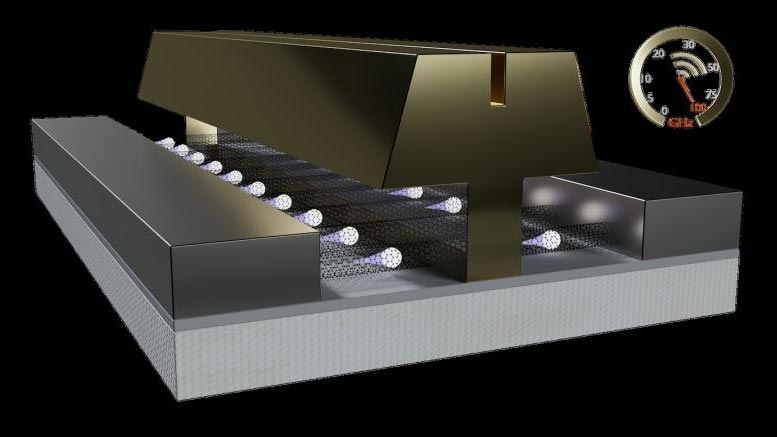
    An Army project developed a carbon nanotube technology that, for the first time, achieved speeds exceeding 100GHz in radio frequency applications, and may boost military communications and sensing technologies. Credit: Carbonics, Inc.

    An Army-funded project may boost 5G and mm-Wave technologies, improving military communications and sensing equipment.

    Carbonics, Inc., partnered with the University of Southern California to develop a carbon nanotube technology that, for the first time, achieved speeds exceeding 100GHz in radio frequency applications. The milestone eclipses the performance — and efficiency — of traditional Radio Frequency Complementary Metal-Oxide Semiconductor, known as RF-CMOS technology, that is ubiquitous in modern consumer electronics, including cell phones.

    “This milestone shows that carbon nanotubes, long thought to be a promising communications chip technology, can deliver,” said Dr. Joe Qiu, program manager, solid-state and electromagnetics at the Army Research Office. “The next step is scaling this technology, proving that it can work in high-volume manufacturing. Ultimately, this technology could help the Army meet its needs in communications, radar, electronic warfare, and other sensing applications.”

    The research was published in the journal Nature Electronics on November 18, 2019.

    The work, funded by ARO, an element of the U.S. Army Combat Capabilities Development Command’s Army Research Laboratory, is a part of a Small Business Technology Transfer Program. The program focuses on feasibility studies leading to prototype demonstration of technology for specific applications.

    For nearly two decades, researchers have theorized that carbon nanotubes would be well suited as a high-frequency transistor technology due to its unique one-dimensional electron transport characteristics. The engineering challenge has been to assemble the high-purity semiconducting nanotubes into densely aligned arrays and create a working device out of the nanomaterial.

    Carbonics, a venture-backed start-up, and USC, successfully overcame this challenge. Projections based on scaling single carbon nanotube device metrics suggest the technology could ultimately far exceed the top-tier incumbent RF technology, Gallium Arsenide.

    Carbonics employs a deposition technology called ZEBRA that enables carbon nanotubes to be densely aligned and deposited onto a variety of chip substrates including silicon, silicon-on-insulator, quartz, and flexible materials. This allows the technology to be directly integrated with traditional CMOS digital logic circuits, overcoming the typical problem of heterogeneous integration.

    “With this exciting accomplishment, the timing is ripe to leverage our CMOS-compatible technology for the 5G and mm-Wave defense communication markets,” said Carbonics’ CEO Kos Galatsis. “We are now engaged in licensing and technology transfer partnerships with industry participants, while we continue to advance this disruptive RF technology.”

    Reference: “Wafer-scalable, aligned carbon nanotube transistors operating at frequencies of over 100 GHz” by Christopher Rutherglen, Alexander A. Kane, Philbert F. Marsh, Tyler A. Cain, Basem I. Hassan, Mohammed R. AlShareef, Chongwu Zhou and Kosmas Galatsis, 18 November 2019, Nature Electronics.
    DOI: 10.1038/s41928-019-0326-y

    In 2014, Carbonics spun out from the joint center of UCLA-USC and King Abdulaziz City for Science and Technology in Saudi Arabia called the Center of Excellence for Green Nanotechnologies.

    The research is based in part, on work funded by the Army more than 10 years ago at University of California Irvine. A graduate student who worked on that project for his doctoral thesis research, Dr. Christopher Rutherglen, is now Carbonics’ chief technology officer.

    Never miss a breakthrough: Join the SciTechDaily newsletter.
    Follow us on Google and Google News.

    Carbon Nanotubes Smartphone Telecommunications Transistors U.S. Army Research Laboratory
    Share. Facebook Twitter Pinterest LinkedIn Email Reddit

    Related Articles

    New Research Advances U.S. Army’s Quest for Ultra-Secure Quantum Networking

    Carbon Nanotube Transistor Advance Paves the Way for 3D Microprocessors

    Breaking Left-Right Symmetry in Optoelectronic Devices for More Energy Efficient Fiber Communications

    Ultra-Clean Carbon Nanotube Transistors With Superior Semiconducting Properties

    Record-Setting Transistor for Cheaper, Faster Wireless Communications

    Coding Scheme Guarantees Fastest Possible Delivery of Data

    Samsung And T-Mobile To Launch A White Galaxy S II

    Going Shopping During the Holidays? Your Phone Might be Watching

    Hackers Attack ATT. Is Your Wireless Phone Safe?

    Leave A Reply Cancel Reply

    • Facebook
    • Twitter
    • Pinterest
    • YouTube

    Don't Miss a Discovery

    Subscribe for the Latest in Science & Tech!

    Trending News

    289-Million-Year-Old Reptile Mummy Reveals Origin of Human Breathing System

    New Brain Discovery Challenges Long-Held Theory of Teenage Brain Development

    Scientists Discover Plants “Scream” – We Just Couldn’t Hear Them Until Now

    Scientists Discover a Surprising Reason Intermittent Fasting Extends Life

    This Simple Fruit Wash Could Make Produce Safer and Last Days Longer

    Scientists Say Adding This Unusual Seafood to Your Diet Could Reverse Signs of Aging

    Scientists Say a Hidden Structure May Exist Inside Earth’s Core

    Doctors Surprised by the Power of a Simple Drug Against Colon Cancer

    Follow SciTechDaily
    • Facebook
    • Twitter
    • YouTube
    • Pinterest
    • Newsletter
    • RSS
    SciTech News
    • Biology News
    • Chemistry News
    • Earth News
    • Health News
    • Physics News
    • Science News
    • Space News
    • Technology News
    Recent Posts
    • 7,000-Year-Old DNA Rewrites the Story of the “Neolithic Revolution”
    • Missing Medieval Relic of Legendary English King Found After Being Missing for 40 Years
    • New Study Challenges Long-Held Assumptions About Cancer and Aging
    • Major Review Finds Alzheimer’s Amyloid Drugs Offer No Real Benefit
    • Could This New Weight-Loss Pill Disrupt the Entire Market? Here’s What You Should Know About Orforglipron
    Copyright © 1998 - 2026 SciTechDaily. All Rights Reserved.
    • Science News
    • About
    • Contact
    • Editorial Board
    • Privacy Policy
    • Terms of Use

    Type above and press Enter to search. Press Esc to cancel.